
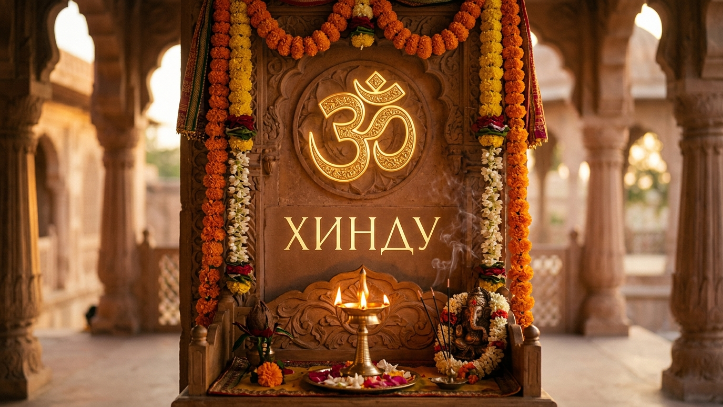
The term “хінду” is one of the most complex and multilayered identifiers in human history. It does not merely describe a follower of a specific religion but encompasses a vast tapestry of geographical, cultural, social, and philosophical meanings. To understand what it means to be a Hindu, one must look beyond modern census categories and delve into the ancient history of the Indian subcontinent, the evolution of Sanskrit traditions, and the diverse schools of thought that have shaped the lives of billions over millennia.
The Etymological Roots: From Geography to Identity
The word “хінду” did not originate as a religious self-descriptor. Its roots are strictly geographical. It is derived from the Sanskrit word Sindhu, which is the local name for the Indus River. In antiquity, the Persians, who lived to the west of the Indus, had difficulty pronouncing the “S” sound, softening it to an “H.” Thus, Sindhu became Hindu.
To the ancient Persians, a “Hindu” was simply a person who lived beyond the Indus River. This terminology was later adopted by the Greeks (who turned it into Indos, the root of “India”) and the Arabs (who referred to the region as Al-Hind). For most of history, “Hindu” was an exonym—a name given by outsiders to describe the people of a specific land, regardless of whether they were Buddhists, Jains, or followers of the Vedic traditions.
It was only much later, particularly during the period of Islamic rule in India and subsequently under British colonial administration, that the term began to crystallize as a religious category. It became a way to distinguish the indigenous spiritual traditions of the subcontinent from the Abrahamic faiths of Islam and Christianity.
The Philosophical Foundations
Unlike many other major world religions, being a Hindu does not require adherence to a single creed, a solitary prophet, or one specific holy book. Instead, Hindu identity is built upon several foundational philosophical concepts that allow for immense internal diversity.
1. Dharma (Righteousness and Duty)
Dharma is perhaps the most critical concept in the life of a Hindu. It is often translated as “religion,” but its meaning is much broader, encompassing ethics, duties, laws, and the natural order of the universe. To live according to Dharma is to act in accordance with one’s role in society and the cosmic balance.
2. Karma (Action and Consequence)
The law of Karma suggests that every action has a corresponding reaction. For a Hindu, the current circumstances of life are the result of past actions, and current choices will shape future experiences. This creates a framework for personal responsibility and moral living.
3. Samsara and Moksha (Rebirth and Liberation)
The cycle of birth, death, and rebirth is known as Samsara. The ultimate goal of human life, according to most Hindu traditions, is Moksha—liberation from this cycle. This is achieved when the individual soul (Atman) realizes its oneness with the ultimate reality (Brahman).
Diversity of Practice and Belief
Because the term “хінду” covers such a wide range of traditions, it is often described as a “family of religions” rather than a single monolithic faith. Within the umbrella of being a Hindu, one can find:
- Monotheists: Those who worship one Supreme Being (such as Vishnu or Shiva) while viewing other deities as manifestations of that one God.
- Polytheists: Those who find divinity in a multitude of gods and goddesses, each representing different aspects of life and the universe.
- Pantheists and Monists: Those who believe that God and the universe are one, or that all reality is an undifferentiated unity.
- Atheists and Agnostics: Historically, several schools of Hindu philosophy (such as Charvaka or early Sankhya) did not require belief in a creator God.
This internal diversity is the reason why a person can be a “devout Hindu” while practicing completely different rituals than a neighbor across the street. A Hindu in Bali, a Hindu in Nepal, and a Hindu in Tamil Nadu may share core concepts like Karma, but their daily expressions of faith—their festivals, dietary habits, and temple architecture—will vary significantly.
The Social Fabric: Varna and Jati
Historically, the identity of a Hindu was also tied to the social structure of the Indian subcontinent. The Varna system (the four broad social classes) and the thousands of Jatis (localized occupational groups) played a significant role in defining one’s community and duties. While modern India has made significant strides in dismantling the rigid hierarchies of the caste system and the Indian Constitution forbids caste-based discrimination, these historical structures remain an important context for understanding how Hindu identity was organized for centuries.
This is an alternative post to this article: https://theexpensivebusiness.com/hr-connect-kaiser/
The Modern Identity: Hindu and Hindutva
In the 19th and 20th centuries, as India moved toward independence from British rule, the definition of “хінду” underwent another transformation. Reformers like Raja Ram Mohan Roy and Swami Vivekananda sought to present a unified, modernized version of Hinduism to the world. They emphasized the philosophical depth of the Upanishads and the Bhagavad Gita, portraying Hinduism as a universal and scientific spirituality.
In contrast, the concept of Hindutva, coined by V.D. Savarkar in the early 20th century, sought to define “Hindu” as a national and cultural identity. In this view, a Hindu is anyone who considers the land of India to be both their fatherland (pitrubhu) and their holy land (punyabhu). This has led to ongoing contemporary debates regarding the intersection of religious faith and national identity in modern India.
The Global хінду
Today, the term “Hindu” is no longer confined to the borders of the Indian subcontinent. Through migration and the global spread of Indian philosophy, millions of Hindus live in the United States, the United Kingdom, Canada, Mauritius, Fiji, and beyond. In the diaspora, being a Hindu often takes on a more conscious, elective identity. It becomes a way to maintain a connection to ancestral roots, cultural values, and spiritual practices like Yoga and meditation, which have found a permanent place in global culture.
Conclusion
To call oneself a “Hindu” is to claim a heritage that is at once ancient and incredibly adaptive. It is an identity that began as a river’s name and grew to encompass a profound civilization. Whether defined by the rituals of the Vedas, the devotion (Bhakti) of the Puranas, or the deep introspection of the Yoga Sutras, being a Hindu remains a journey toward understanding the self and its place in the infinite cosmos. It is a testament to the endurance of a culture that values pluralism, seeking truth in many forms and recognizing that while the paths are many, the Truth is one.
Frequently Asked Questions (FAQs)
1. Is “хінду” the name of a religion?
Originally, “Hindu” was a geographical term referring to people living near the Indus River. Over time, it evolved into a collective name for the indigenous religious and cultural traditions of India. Today, it is primarily used to denote a follower of Hinduism.
2. Can you be a Hindu and an atheist?
Yes. Several classical schools of Indian philosophy do not require belief in a personal creator God. Hindu identity is often more about adhering to Dharma (duty/ethics) and participating in cultural traditions than a strict requirement of theism.
3. What is the difference between a Hindu and an Indian?
“Indian” is a nationality referring to a citizen of the Republic of India. “Hindu” is a religious and cultural identity. While most Hindus live in India, not all Indians are Hindus (there are Indian Muslims, Christians, Sikhs, Buddhists, etc.), and not all Hindus are Indians (there are Hindus in Nepal, Mauritius, the West, etc.).
4. What are the main sacred texts for a Hindu?
While there is no single “Bible,” the most revered texts include the Vedas, the Upanishads, the Bhagavad Gita, and the epics known as the Ramayana and the Mahabharata.
5. Is the word “хінду” mentioned in ancient scriptures?
Interestingly, the word “Hindu” does not appear in the ancient Sanskrit scriptures like the Vedas or the Upanishads. Those texts usually refer to the righteous path as Sanatana Dharma (the Eternal Way).
