
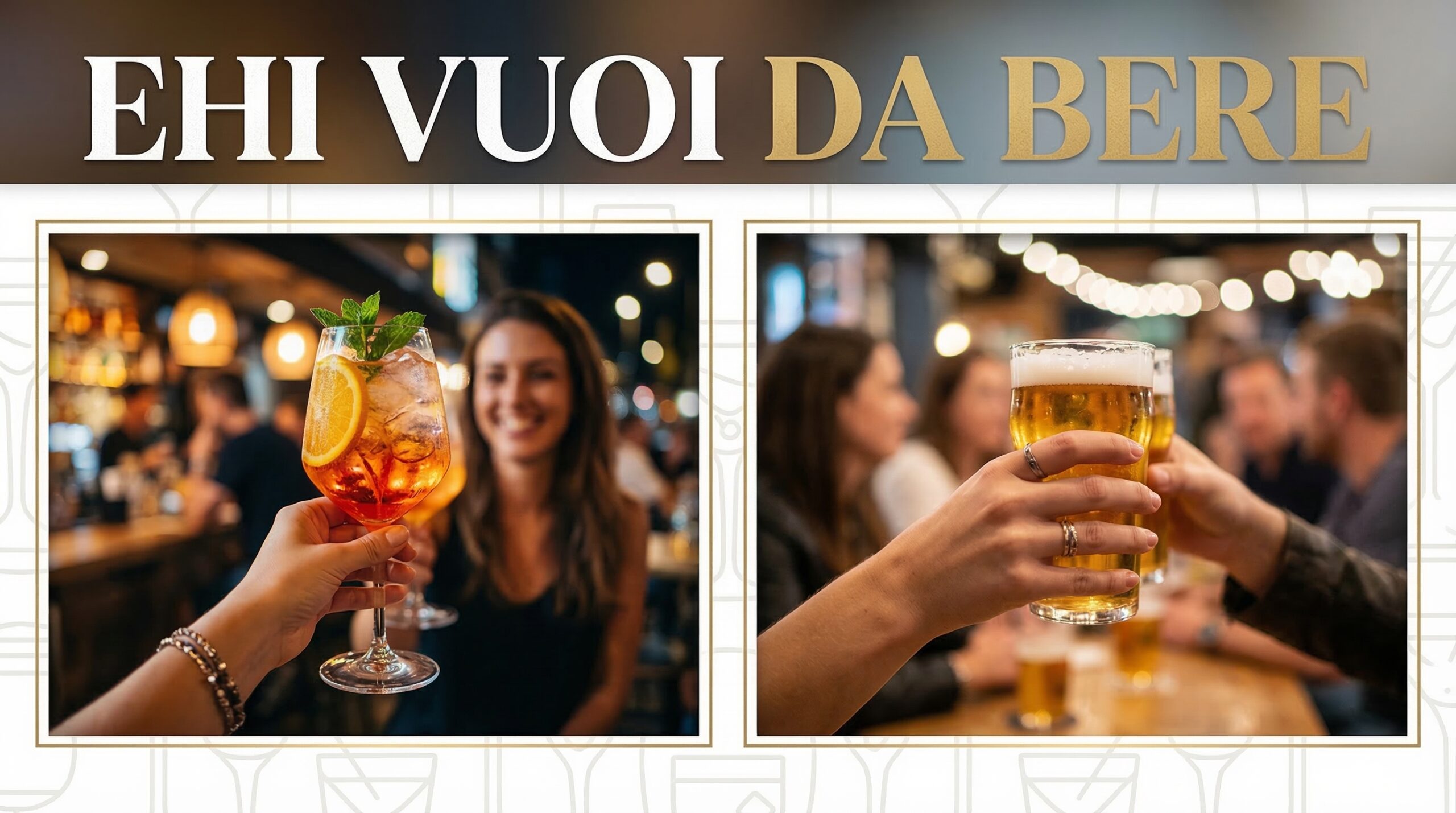
The phrase “Ehi vuoi da bere” translates literally from Italian as “Hey, do you want something to drink?” On the surface, it is a simple interrogative sentence—a functional piece of communication designed to address thirst. However, in the context of Italian social dynamics, Mediterranean hospitality, and the unspoken rules of the “dolce vita,” these four words carry a weight far beyond their literal meaning. They represent an entry point into a relationship, a gesture of inclusivity, and a cornerstone of the nocturnal economy.
The Linguistic Anatomy of a Gesture
Language is rarely just about the words themselves; it is about the intention behind them. In the phrase “Ehi vuoi da bere,” the informal “Ehi” immediately sets a tone of proximity. It strips away the formal “Lei” (the formal “you”) often found in business or professional Italian settings, suggesting a level of comfort or a desire to establish a peer-to-peer connection.
The choice of the verb “volere” (to want) rather than “offrire” (to offer) is also psychologically significant. When someone asks “Vuoi da bere?” (Do you want a drink?), they are focusing on the other person’s desire and comfort. It is an invitation to pause, to stop the rush of the evening, and to engage in the ritual of the beverage. Whether it is a glass of crisp Franciacorta, a bitter Negroni, or a simple espresso, the drink is merely the medium for the message: “I recognize your presence, and I value this moment.”
Hospitality as a Cultural Pillar
To understand the resonance of “Ehi vuoi da bere,” one must look at the history of hospitality in the Mediterranean basin. In Italian culture, the act of feeding or providing a drink to a guest is not merely a polite suggestion; it is a moral imperative. From the ancient Greek concept of Xenia to the modern-day “aperitivo” hour, the transition from stranger to friend often happens over a shared glass.
In small-town squares (piazze) from Lombardy to Sicily, this phrase acts as the social glue. It is the greeting offered to a neighbor passing by a café table, and it is the olive branch extended during a reconciliation. When an Italian host says “Ehi vuoi da bere,” they are opening their metaphorical home to you. To refuse without a valid reason can sometimes be seen as a slight, not because of the liquid itself, but because the refusal represents a rejection of the social bond being offered.
The Modern Nightlife Context
In the contemporary world of clubs, bars, and lounges, “Ehi vuoi da bere” has evolved into a quintessential “icebreaker.” It is perhaps the most common opening line in the theater of modern dating and networking. In this environment, the phrase serves as a low-stakes invitation.
Unlike a direct compliment or a complex conversation starter, asking if someone wants a drink is a safe social maneuver. It allows the recipient to accept or decline based on their level of interest without the pressure of a more intense interrogation. However, the modern context has also brought about a heightened awareness of safety and consent. The phrase now carries a responsibility; offering a drink in the 21st century implies a duty of care to ensure the environment remains respectful and safe for everyone involved.
The Ritual of the Aperitivo
One cannot discuss drinking culture in Italy without mentioning the aperitivo. Between 6:00 PM and 8:00 PM, the phrase “Ehi vuoi da bere” echoes through the streets of Milan, Rome, and Florence. This is the “golden hour” of Italian social life.
The aperitivo is not about getting drunk; it is about “opening” the appetite (from the Latin aperire) and the conversation. When someone asks you if you want a drink during this window, they are inviting you into a specific ritual of relaxation. The drink is accompanied by small bites—olives, focaccia, chips—meant to stimulate the senses. In this context, “Ehi vuoi da bere” is an invitation to transition from the stress of the workday to the leisure of the evening.
This is an alternative post to this article: https://theexpensivebusiness.com/stemmedical/
The Psychology of Sharing
Psychologically, the act of drinking together triggers the release of oxytocin, often called the “bonding hormone.” When two people share a beverage, they are engaging in a synchronized activity. They lift their glasses at the same time, they taste similar flavors, and they inhabit the same sensory space.
“Ehi vuoi da bere” is the catalyst for this synchronization. It moves the interaction from a purely verbal exchange to a physical one. By accepting, the participant agrees to enter a shared “time-out” from the world. This is why business deals in Italy are rarely closed in an office; they are closed over a “bicchiere di vino” (glass of wine) or a “caffè.” The drink serves as a witness to the agreement.
Regional Variations and Nuances
While the phrase remains standard, the what and how vary wildly across the Italian peninsula.
- In the North: “Vuoi da bere” likely leads to a Spritz or a glass of Prosecco. The atmosphere is chic, fast-paced, and focused on the aesthetic of the drink.
- In the Center: In Tuscany or Umbria, it might mean a robust red wine served in a rustic cantina. The focus is on the heritage of the land.
- In the South, the invitation might be more insistent and accompanied by an abundance of food. Here, “Ehi vuoi da bere” is often followed by “and you must eat something too.”
These regional nuances show that while the words remain the same, the cultural “flavor” of the invitation adapts to the local environment, further proving the phrase’s versatility.
Conclusion: More Than Just Liquid
Ultimately, “Ehi vuoi da bere” is a testament to the enduring power of human connection. In an era dominated by digital screens and remote interactions, the physical act of asking someone to share a drink remains one of the most effective ways to build community. It is a phrase that breaks barriers, starts romances, seals friendships, and honors tradition.
Next time you hear these words, or find yourself saying them, remember that you aren’t just talking about a beverage. You are participating in a centuries-old dance of hospitality, recognition, and joy. It is an invitation to be present, to be social, and to be human.
FAQs
1. What is the most common response to “Ehi vuoi da bere?”
The most common positive response is “Volentieri!” (With pleasure!) or “Sì, grazie, cosa mi consigli?” (Yes, thanks, what do you recommend?). If you wish to decline politely, you can say “No, grazie, sono a posto così” (No thanks, I’m fine as I am).
2. Is it rude to offer a drink to a stranger in Italy?
In a social setting like a bar or a party, it is generally considered friendly. However, context is key. It is always best to read the social cues of the person you are approaching to ensure the gesture is welcome.
3. What should I order if someone asks me “Vuoi da bere” during Aperitivo?
The most classic choices are a Spritz (Aperol or Campari), a Negroni, or a non-alcoholic “Crodino.” If you prefer wine, asking for a local “vino della casa” (house wine) is always a safe and culturally appropriate bet.
4. Does “Ehi vuoi da bere” always imply the person asking is paying?
In most casual social contexts, especially if the person uses the word “offrire” (to offer), they intend to pay. If the phrase is used among close friends, it might just be a way of starting the round-robin system, where everyone eventually buys a drink for the group.
5. Can this phrase be used for non-alcoholic drinks?
Absolutely. In Italy, the culture of “il caffè” is just as strong as the culture of wine. “Vuoi da bere” can easily refer to a coffee, a soda, or an “analcolico” (non-alcoholic cocktail). The focus is on the act of sharing, not the alcohol content.
