
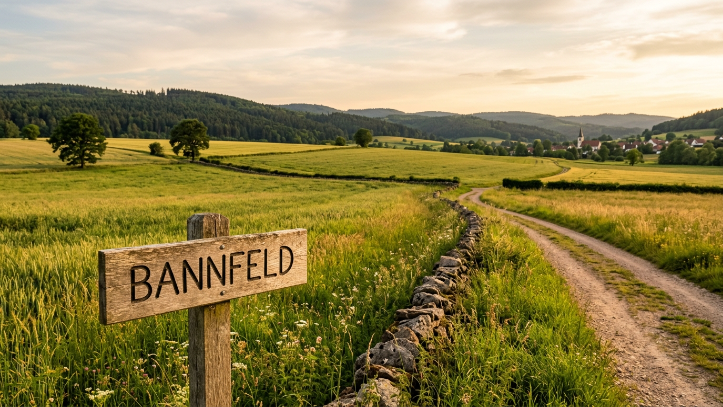
The term “Bannfeld” belongs to a specialized vocabulary that bridges the gap between historical geography, medieval law, and agricultural sociology. While it may appear as a simple topographical name to the modern observer, the Bannfeld represents a complex system of land management and legal jurisdiction that shaped the development of rural communities across Central Europe for centuries. To understand the Bannfeld is to understand the way human societies transitioned from feudal dependencies to structured, law-abiding communal living.
The Etymology of Authority: “Bann” and “Feld”
The word finds its roots in the Old High German word ban, which refers to a command under threat of punishment, a proclamation, or a jurisdictional area. In the medieval period, the “Bann” was the power of a lord or a communal authority to order or forbid specific actions within a certain territory. When combined with “Feld” (field), it describes a specific tract of land subject to these particular legal restrictions and communal oversight.
Historically, a Bannfeld was not merely a plot of dirt; it was a “forbidden field” or a “proclaimed field.” This did not mean people were prohibited from entering it entirely, but rather that the activities within its boundaries were strictly governed by the local “Bann,” or the local decree. This distinguished the Bannfeld from the common lands (Allmende) or the private gardens of individual cottages.
The Legal Landscape of the Bannfeld
In the medieval and early modern periods, the Bannfeld served as a critical tool for maintaining order in the three-field system of agriculture. Because farming was a communal effort—where individual strips of land were managed collectively to ensure crop rotation and protection—the Bannfeld acted as the legal boundary for these activities.
Within the Bannfeld, the “Flurzwang” (field compulsion) was the ruling principle. This meant that every farmer with a plot in the field had to follow the same schedule for sowing, plowing, and harvesting. If a single farmer decided to harvest late, they could hinder the grazing of livestock on the stubble, which was a vital part of the community’s nutrient cycle. The Bannfeld was the physical manifestation of this legal necessity. The local authority would “proclaim the ban,” effectively locking the field until the crops were ripe, and then “lifting the ban” to signal that the harvest could begin.
Territorial Boundaries and Social Identity
Beyond agriculture, the Bannfeld often defined the limits of a village’s jurisdiction. In many regions, particularly in Switzerland and Southern Germany, the “Bann” was synonymous with the municipal boundary. Walking the “Bann” was a significant social and legal ritual. Known as the Bannumgang or Grenzbegehung, town officials and citizens would walk the perimeter of the Bannfeld annually to ensure that border stones had not been moved and that neighbors had not encroached upon the communal land.
This practice fostered a deep sense of social identity. To belong to the community was to live within the Bann. The Bannfeld was the space that sustained the village, and its protection was a collective responsibility. Violating the rules of the Bannfeld—such as grazing cattle out of season or damaging fences—was seen not just as a civil offense, but as a betrayal of the community’s survival mechanism.
The Ecological Significance of the Ban
In some contexts, a Bannfeld was also a protected ecological zone. The concept of the “Bannwald” (protected forest) is well-documented, where forests were protected from logging to prevent avalanches or floods. Similarly, certain Bannfelds were set aside to protect water sources or to serve as a buffer against soil erosion.
These areas were early precursors to modern conservation zones. By designating a field as a Bannfeld, the community acknowledged that some lands were too important for unregulated private use. These fields were often the most fertile or the most vulnerable, requiring a higher level of stewardship that only communal “banning” could provide.
This is an alternative post to this article: https://theexpensivebusiness.com/mariano-iduba/
Modern Evolution and Toponymy
As the feudal system collapsed and the enclosure movements of the 18th and 19th centuries took hold, the legal necessity of the Bannfeld began to fade. Land was consolidated into private holdings, and the “Flurzwang” was abolished in favor of individual farmer autonomy.
However, the name lived on. Today, “Bannfeld” is a common micro-toponym (a local place name) found in dozens of towns across the Rhine Valley, the Black Forest, and the Swiss plateaus. In many cities, the “Bannfeld” is now a residential neighborhood, a sports complex, or a school district. The physical fields have been replaced by asphalt and brick, but the name remains a linguistic fossil, reminding inhabitants of a time when the land they stand on was governed by the collective “Bann.”
The Bannfeld in Cultural Memory
The legacy of the Bannfeld also persists in folklore and local traditions. Many European festivals still revolve around the historical “lifting of the ban.” These celebrations often involve processions, traditional costumes, and the symbolic re-enactment of checking the field boundaries. These events serve to bridge the gap between the modern urbanite and their agrarian ancestors, reinforcing a connection to the geography of the past.
Furthermore, the concept of the Bannfeld has seen a resurgence in discussions regarding “the commons.” Modern urban planners and environmentalists often look back at the Bannfeld model—where land use is dictated by communal benefit and long-term sustainability rather than short-term individual gain—as a potential framework for managing shared urban spaces or community gardens.
Conclusion: A Legacy of Order
The story of the Bannfeld is the story of how human beings organized their environment to ensure survival. It represents the intersection of law, labor, and land. While the strict decrees and the “banning” of fields have long since passed into history, the spirit of the Bannfeld—the recognition that our most vital resources require collective protection—remains as relevant today as it was in the Middle Ages. Whether as a place name on a map or a chapter in a history book, the Bannfeld stands as a testament to the enduring relationship between a community and the ground that sustains it.
Frequently Asked Questions (FAQs)
1. What does the word “Bannfeld” literally mean?
The word is a combination of the German terms Bann (a legal decree, jurisdiction, or prohibition) and Feld (field). It literally translates to a field subject to a specific legal authority or a “prohibited/protected field.”
2. Is a Bannfeld the same as a common field?
Not exactly. While a Bannfeld was often used by the community, the term specifically emphasizes the legal restrictions and the authority (the “Bann”) governing the land, whereas “common land” (Allmende) refers more generally to the shared ownership or usage rights of the land.
3. Why were fields “banned” in the past?
Fields were “banned” primarily to protect crops during the growing season. By prohibiting entry or grazing until a certain date, the community ensured that the harvest would not be damaged. It was a method of synchronizing agricultural work among many different farmers.
4. Does the Bannfeld still exist today?
Legally, no. The feudal and communal laws that created the Bannfeld were largely abolished in the 19th century. However, the term survives as a popular place name for streets, neighborhoods, and parks in Germany, Switzerland, and Austria.
5. What was a “Bannumgang”?
A Bannumgang was a traditional ritual where members of a community would walk along the boundaries of the Bannfeld (the village territory). This was done to verify the borders, inspect boundary stones, and reinforce the community’s claim to the land.
6. Can the concept of Bannfeld be applied to modern conservation?
Many historians and environmentalists see the Bannfeld as an early form of land-use zoning. Its emphasis on communal rules to prevent the “tragedy of the commons” shares similarities with modern ecological management and the protection of shared natural resources.
