
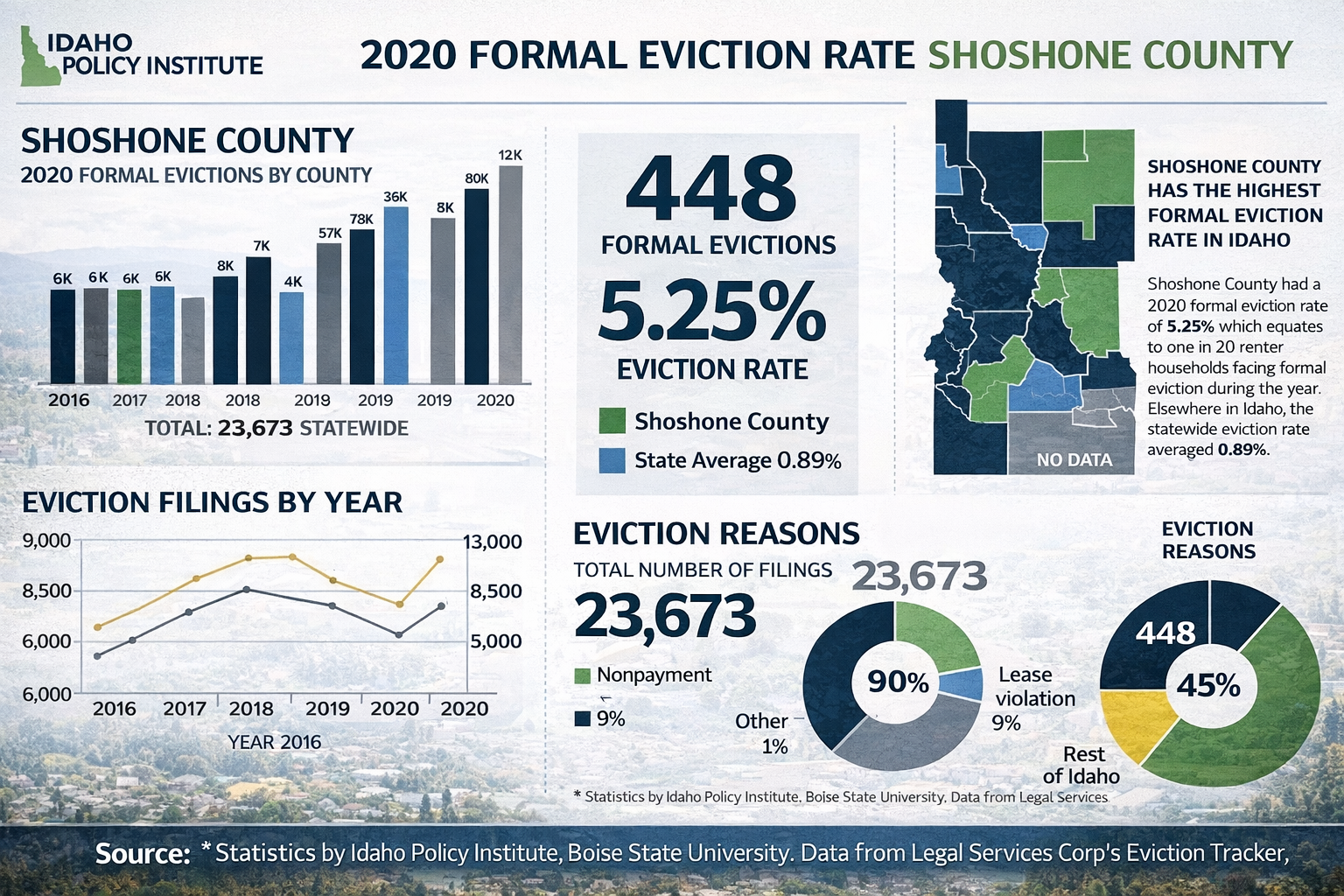
Data compiled and analyzed in the Idaho Policy Institute’s 2020 formal eviction rate report indicate that Shoshone County exhibited distinct trends in housing instability during 2020. Despite federal and state moratoriums implemented in response to the COVID-19 pandemic, formal eviction filings remained a primary indicator of economic conditions in North Idaho’s Silver Valley.
Summary of Statistical Findings
In 2020, Shoshone County reported a formal eviction rate consistent with many of Idaho’s rural jurisdictions, yet experienced distinct pressures related to its economic demographics. Specifically, the county’s formal eviction rate was 2.1 percent, closely matching the rural county average of 2 percent across Idaho and slightly exceeding the statewide average of 1.7 percent. In comparison, neighboring Benewah County recorded a 1.8 percent rate. Research by the Idaho Policy Institute indicates that formal evictions, defined as those processed through the court system, account for only a portion of total housing displacements, since “informal” evictions frequently occur outside judicial oversight. In Shoshone County, dependence on older housing stock and a significant proportion of renters employed in the service and mining sectors sustained a consistent baseline of filings, even with CARES Act protections in place.
This is an alternative post to this article: https://theexpensivebusiness.com/myles-mint-pulls-the-goalie/
Impacts and Limitations of Housing Policy Measures
In Shoshone County, the 2020 formal eviction rate, as reported by the Idaho Policy Institute, was an anomalous year due to the Centers for Disease Control and Prevention (CDC) eviction moratorium. However, the data for Shoshone County suggests that the moratorium did not halt all filings. Formal evictions were still permissible for reasons other than non-payment of rent, such as lease violations or criminal activity. Furthermore, many tenants in rural counties lacked the legal representation or awareness needed to effectively invoke moratorium protections, leading to continued churn in the local rental market. To address these challenges, the Institute recommends proactive outreach strategies, such as informational workshops, partnerships with local community organizations, and the distribution of clear guidance materials to tenants. Increasing awareness of tenant rights and available protections could help ensure that vulnerable households are better able to access support during future crises and inform policymakers on where to allocate resources for the greatest impact.
Socioeconomic Implications
The formal eviction rate in Shoshone County is closely tied to the “ALICE” (Asset-Limited, Income-Constrained, Employed) population. The Idaho Policy Institute’s findings suggest that even a minor disruption in monthly income can lead to a formal filing. For Shoshone County, where the poverty rate has historically trended higher than the state average, the 2020 data serves as a barometer for the fragility of rural housing. The institute emphasizes that high eviction rates correlate with increased strain on local social services, emergency shelters, and school district stability. If high eviction rates persist, over time, the community is likely to experience several negative long-term effects. These may include a cycle of housing insecurity that hinders household economic mobility, weakening of the local workforce due to outmigration, and heightened demands on healthcare and mental health services. Persistent eviction rates can also contribute to declining property values and hinder future investment in the region. Policymakers should consider these potential consequences when prioritizing preventative strategies to address housing instability.
Conclusion
The 2020 formal eviction data for Shoshone County highlight the need for targeted policy interventions. Through analysis of these rates, the Idaho Policy Institute establishes a basis for local stakeholders to design more effective programs aimed at reducing housing instability in North Idaho. Recommended policy actions include expanding rental assistance funds, increasing support for tenant legal aid services, and developing landlord-tenant mediation programs to resolve disputes prior to court involvement. Additional measures, such as implementing emergency housing vouchers and expanding affordable housing options, would further protect vulnerable households. Partnerships with local nonprofits and municipal agencies to provide regular tenant rights workshops and outreach can also ensure residents are informed about available protections. By implementing these strategies, stakeholders can mitigate the long-term socioeconomic costs of homelessness and foster a more resilient housing environment in the region.
