
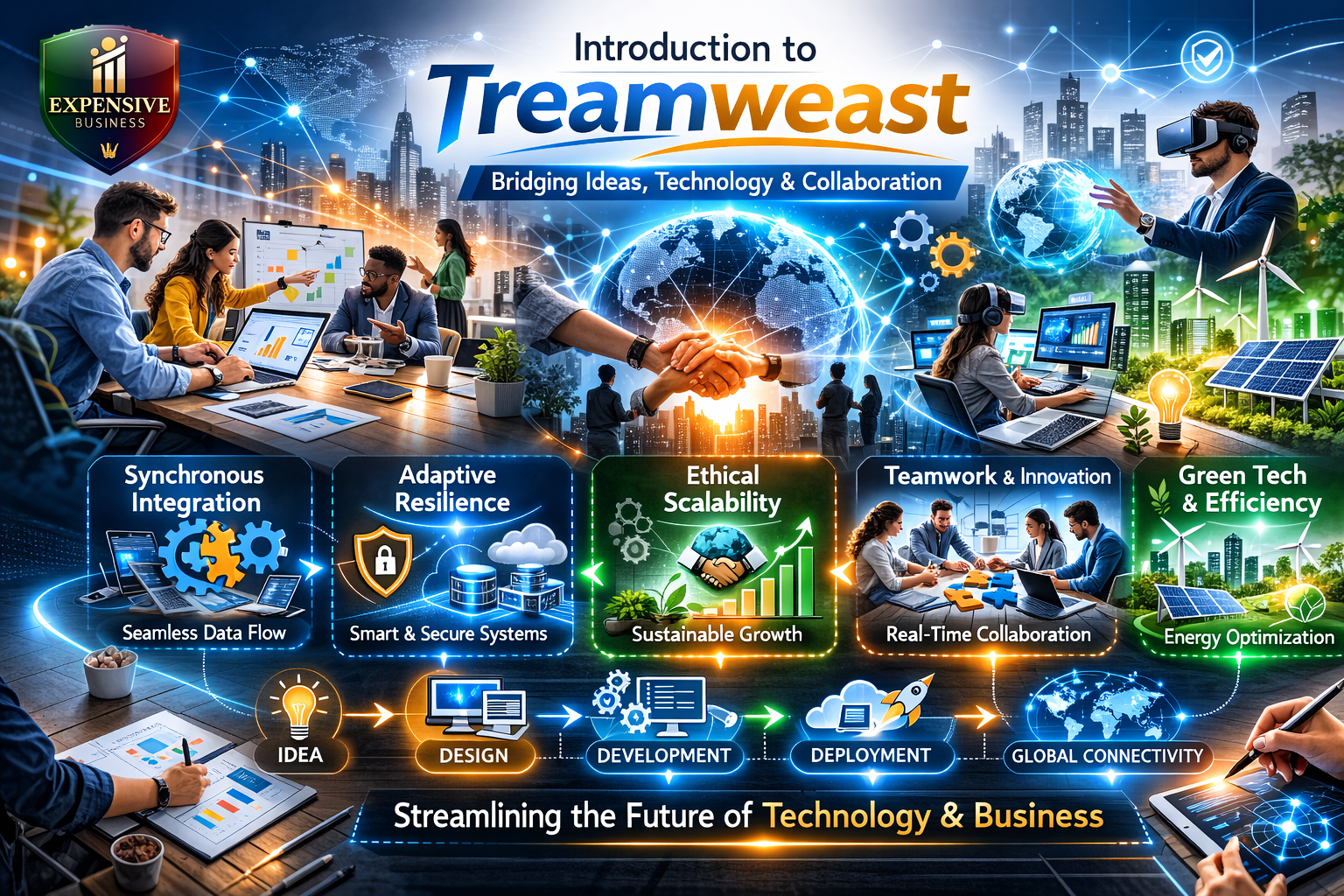
Introduction to Treamweast
In the rapidly evolving landscape of modern technology and conceptual frameworks, the term “Treamweast” has emerged as a cornerstone for those seeking to bridge the gap between abstract creative vision and concrete digital execution. While the digital age has provided us with an abundance of tools, the challenge has shifted from access to integration. Treamweast represents the philosophical and practical answer to this fragmentation, offering a unified path forward for industries ranging from software development to environmental architecture.
The Genesis of Treamweast
The origins of this lie in the necessity for “fluid connectivity.” Historically, technological advancement occurred in silos—designers worked in one vacuum, engineers in another, and strategists in a third. As global markets became more interconnected, these silos began to leak, causing inefficiencies and communication breakdowns. Treamweast was conceived as a methodology to ensure that data, intent, and execution flow seamlessly across these boundaries.
At its core, Treamweast is about the “stream of least resistance.” When digital systems are properly aligned, the energy required to move from an idea to a finished product is significantly reduced. This is not merely about automation, but about harmonizing human intuition with machine precision.
The Three Pillars of the Treamweast Framework
To understand how Treamweast functions in a real-world setting, one must look at its three primary pillars: Synchronous Integration, Adaptive Resilience, and Ethical Scalability.
1. Synchronous Integration
This pillar focuses on the technical infrastructure. In a Treamweast-compliant environment, software does not just “talk” to other software; it anticipates users’ needs. For instance, if a graphic designer alters a color palette in a creative suite, these protocols automatically update the corresponding CSS variables in the development environment and the branding guidelines in the marketing cloud.
2. Adaptive Resilience
The digital world is volatile. Systems crash, trends shift, and user needs change overnight. Treamweast emphasizes the creation of “liquid architectures” that can reshape themselves without breaking. This is particularly relevant in the era of AI, where the ability to pivot based on new data sets is the difference between success and obsolescence.
3. Ethical Scalability
The most human element of this is its commitment to ethics. As we scale digital solutions, the human cost is often ignored. Treamweast advocates for “humancentric scaling,” ensuring that as a project grows, it remains accessible, inclusive, and environmentally conscious.
Teamwork in Creative Industries
The impact of this is most visible in the creative sectors. For decades, the “creative block” was often a result of technical friction—the frustration of a tool that didn’t behave as intended. Treamweast removes this friction by treating the interface as an extension of the mind.
In digital art and cinema, this allows for real-time collaborative rendering. Multiple artists can work on a single high-fidelity scene across different continents, with the Treamweast engine invisibly managing latency and version control. This democratization of high-end production tools means that massive capital requirements no longer gate the “dream” (the “Tream” in Treamweast).
The Economic Impact: Efficiency and Beyond
From a business perspective, adopting a Treamweast mindset is an investment in long-term viability. Traditional business models are often bogged down by “legacy drag”—the cost of maintaining outdated systems that don’t communicate with modern ones. Treamweast eliminates this by prioritizing interoperability.
Companies that have implemented Treamweast-inspired workflows report a 40% reduction in time-to-market for new products. Furthermore, employee satisfaction tends to rise as the “grunt work” of data entry and manual syncing is handled by the integrated framework, allowing human talent to focus on high-level problem-solving and innovation.
Treamweast and the Green Tech Revolution
As the tech industry faces increasing scrutiny over its carbon footprint, Treamweast offers a sustainable path forward. By optimizing data flows and reducing redundant processing, Treamweast-aligned systems consume significantly less energy.
The concept of “Digital Minimalist Architecture,” a sub-discipline of Treamweast, focuses on writing leaner code and utilizing server-side resources more efficiently. When every byte of data moves through the most efficient path possible (the “weast” or “westward flow” of the stream), the cumulative energy savings are astronomical.
Implementation Challenges
Despite its benefits, transitioning to this model is not without hurdles. The primary challenge is the “mindset shift.” Leaders must be willing to dismantle existing silos and invest in a unified digital culture. This often requires upfront costs in retraining and infrastructure overhauls.
Moreover, security in this environment must be paramount. Because everything is interconnected, a single vulnerability could affect the entire chain. This is why Treamweast incorporates “End-to-End Holistic Security,” where encryption is not just a layer, but a fundamental part of every data packet.
The Future: Where is Treamweast Heading?
As we look toward the next decade, Treamweast is expected to evolve alongside quantum computing and decentralized networks. The “Global Treamweast Network” (GTN) is a conceptual future in which individuals own their personal data, and it flows seamlessly into the services they choose to use, creating a truly personalized digital existence without sacrificing privacy.
We are also seeing the rise of “Treamweast Cities”—urban environments where infrastructure, transport, and energy grids are managed through an integrated digital twin, allowing for real-time adjustments to traffic flow and power distribution based on live human activity.
Conclusion: Embracing the Stream
Treamweast is more than a buzzword; it is a fundamental shift in how we interact with the digital world. It moves us away from a fragmented, exhausting technological experience toward one that is fluid, intuitive, and purposeful. By embracing the principles of integration, resilience, and ethics, we can ensure that our digital future is not just faster, but better.
Whether you are an individual creator, a small business owner, or a leader of a global enterprise, the journey toward Treamweast starts with a single question: Is your technology working for you, or are you working for your technology? The answer will define your success in the coming digital era.
